Uninterruptible Power Supply (UPS) System

Reliable Power Protection for Critical Infrastructure

Businesses and critical infrastructure depend on stable and uninterrupted electrical power. Even a brief power interruption can disrupt operations, damage equipment, or lead to costly downtime. Uninterruptible Power Supply (UPS) systems are designed to protect sensitive electrical loads by delivering continuous power and maintaining stable voltage during grid disturbances or outages.

Quantum Power Guard UPS Systems

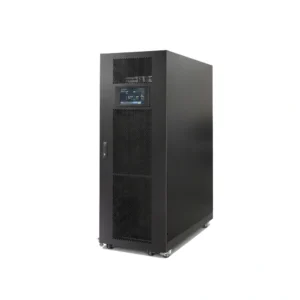
Quantum Power Guard UPS solutions support a wide range of environments including data centers, healthcare facilities, commercial operations, and industrial applications. Built for continuous operation as these systems help maintain power quality, protect connected equipment, and ensure operations remain stable when utility power becomes unstable or unavailable.

Our UPS platforms combine advanced power conversion technology, intelligent monitoring, and scalable battery integration to deliver reliable backup power for mission critical environments.
Core Capabilities

Instant Backup Power

UPS systems switch to battery power instantly when grid power fails, ensuring connected equipment continues operating without interruption.

Scalable Power Architecture

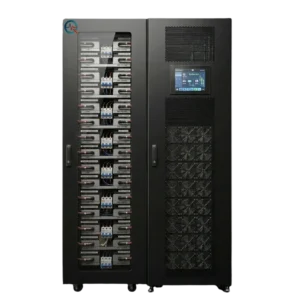
Modern UPS platforms allow modular expansion to support growing electrical loads and infrastructure requirements.

Power Conditioning

Uninterruptible Power Supply UPS systems regulate voltage fluctuations, surges, and electrical noise to protect sensitive electronic equipment.

Continuous Monitoring

Integrated for monitoring platforms thus provide real-time system status, performance insights, and predictive maintenance alerts.
Explore Our Modular UPS Solutions
Explore the Modular UPS products offered by Quantum Power Guard according to your system design.

How Uninterruptible Power Supply (UPS) Works

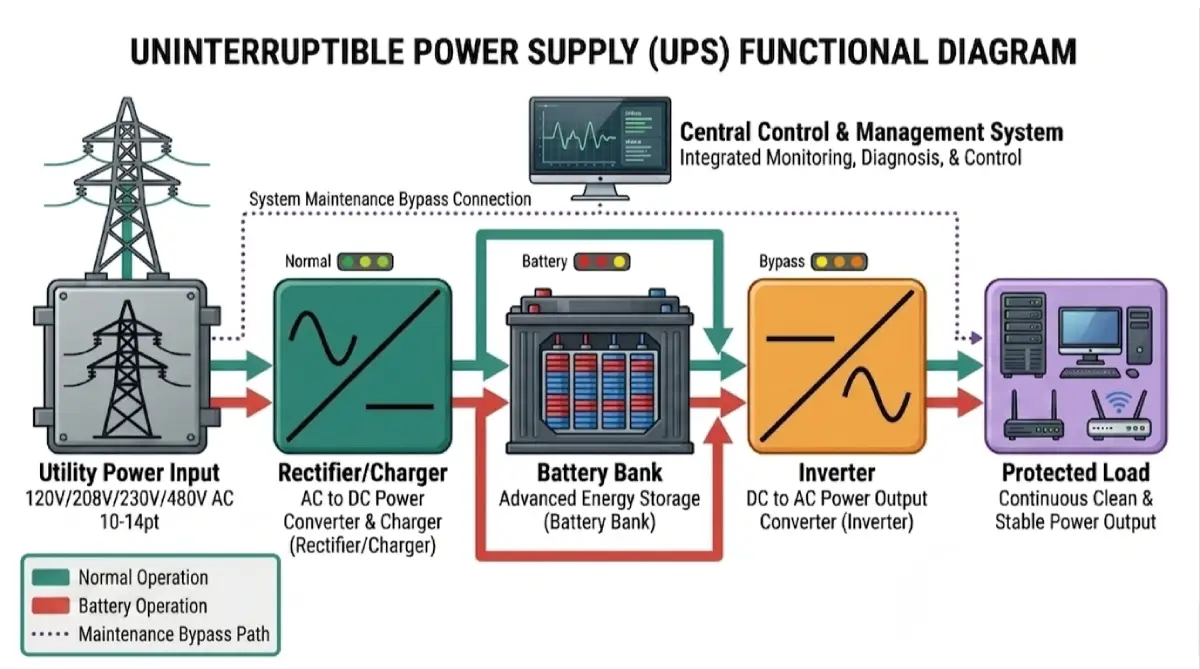
A UPS system operates as an intelligent interface between the utility power source and critical equipment, ensuring continuous, stable electricity even during outages or voltage disturbances. The Core Components are as follows.
  • Rectifier and Charger: This component takes the incoming AC power from the wall and converts it into DC power to keep the batteries charged and ready.
  • Battery Bank: This is the storage center that holds energy for use during an outage.
  • Inverter: This is the “brain” of the output side. It takes DC energy from the battery or rectifier and turns it back into clean, stable AC power for your equipment.
  • Static Bypass: This acts as a safety switch. It allows the system to pull power directly from the utility if the UPS experiences an internal fault or needs maintenance.
How Uninterruptible Power Supply (UPS) Works
Normal Operation Mode
  • Continuous monitors incoming voltage and frequency
  • Keeps the battery fully charged and ready
  • Filters minor fluctuations, spikes, and electrical noise
  • Ensures consistent and clean power delivery to sensitive systems
Backup Operation Mode
  • Detects voltage drops, outages, or instability within milliseconds
  • Instantly switches to battery power with no noticeable interruption
  • Automatically returns to utility power once conditions
  • Recharges batteries in preparation for the next outage
Internal Power Conversion
  • Accepts AC power from the utility grid
  • Converts AC to DC for battery storage
  • Converts DC back to AC for output to connected loads
  • Acts as a protective barrier against unstable grid power

Frequently Asked Questions

What is an Uninterruptible Power Supply (UPS) system?
An uninterruptible power supply (UPS) system provides continuous electrical power to critical equipment during power outages or voltage disturbances. It protects infrastructure by delivering instant backup power and maintaining stable electrical output.
Can a UPS work if the battery is removed?
No, the battery is the component that provides power during a failure. Some models feature a bypass mode to allow utility power through during battery service, but the backup function will not work without a healthy battery.
What industries use UPS systems?
Uninterruptible Power Supply (UPS) systems are commonly used in data centers, healthcare facilities, manufacturing plants, telecommunications networks, financial institutions, and other critical infrastructure environments.
Why are UPS systems important for data centers?
Data centers rely on uninterrupted power to keep servers, networking equipment, and storage systems operating continuously. UPS systems provide instant backup power and protect equipment from voltage fluctuations that could lead to downtime or data loss.
Why is an Online UPS better for servers?
An Online or Double-Conversion UPS provides zero transfer time. Because the equipment always runs on processed power from the inverter, there is no risk of a crash during the switch to battery.
Scroll to Top