
Synchronization Advantage
Why Synchronization Matters
Power conditions inside a data center are constantly changing. Server loads increase and decrease, voltage levels fluctuate, and harmonic distortions can appear on the electrical line. Traditional UPS systems treat power protection as a simple on or off event where the grid is either stable or failing. In reality, power conditions are rarely that simple.
How Conventional UPS Systems Work
Most traditional UPS systems react only when a clear problem occurs such as a voltage drop or a full outage. Until that point, the system assumes the incoming power is acceptable. This reactive approach can allow smaller fluctuations, imbalances, and distortions to affect sensitive IT equipment over time.
The Quantum Power Guard Approach
Quantum Power Guard systems are designed to operate differently. Instead of waiting for a failure, the system continuously monitors both incoming and outgoing power conditions in real time.
The Quantum Power Guard Synchronization Engine analyzes voltage stability, load behavior, and waveform quality of 10000 times every second. Based on this information, the inverter dynamically adjusts its output so the power delivered to your infrastructure stays stable and consistent.
This approach keeps critical infrastructure operating smoothly while reducing unnecessary stress on batteries and electrical components.
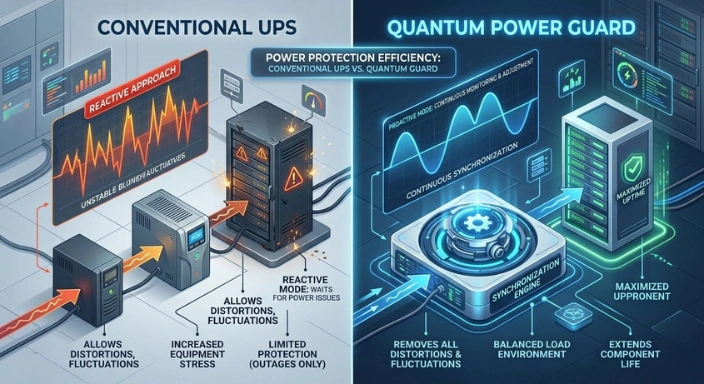
Comparison: Conventional UPS vs Quantum Power Guard
| Challenge | Conventional Approach | Quantum Power Guard |
|---|---|---|
| Load Imbalance | Overprovision capacity | Auto balance across phases |
| Harmonic Distortion | Passive filtering | Active waveform correction |
| Battery Wear | Scheduled replacement | Usage based predictive alerts |
| Maintenance | Full system shutdown | Hot swap any module |